
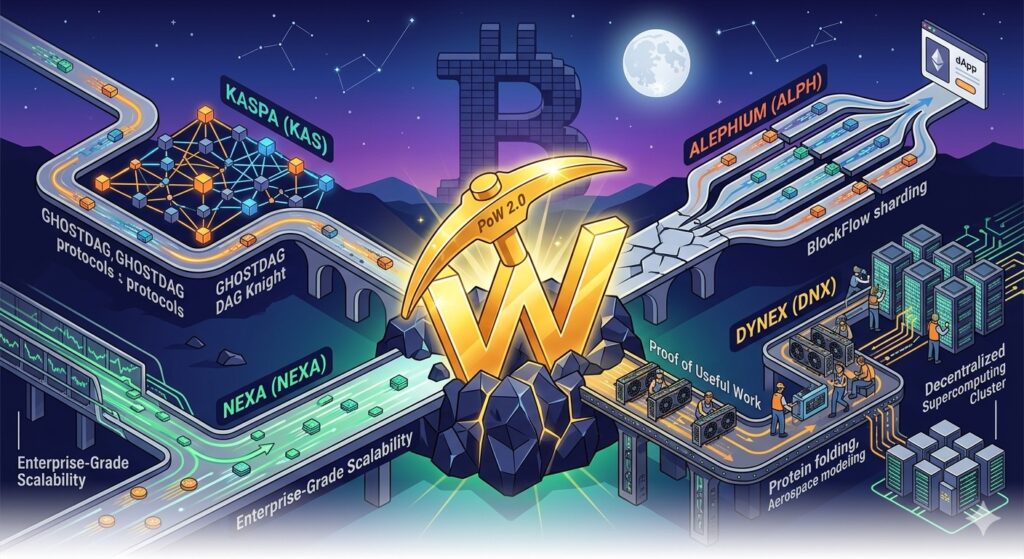

The cryptocurrency market has entered a transformative era where the long-standing dominance of Proof of Work (PoW) is being challenged not by Proof of Stake, but by more advanced versions of itself. While Bitcoin remains the undisputed king of digital gold, its limitations in scalability and transaction speed have created a vacuum for innovative “PoW 2.0” projects. These new protocols leverage groundbreaking architectures such as Directed Acyclic Graphs (DAGs) and sharding to deliver performance that was once thought impossible for decentralized, mined networks.
The search for the next Bitcoin-killer isn’t just about finding a faster coin; it is about identifying projects that solve the “Blockchain Trilemma” without compromising on the security and decentralization that only mining can provide. For investors and miners alike, these emerging projects offer a unique value proposition: the fair launch and robust security of PoW combined with the utility of modern smart contract platforms. In this deep dive, we evaluate the most promising PoW projects that are technically equipped to compete with, or even surpass, Bitcoin’s utility.
Kaspa (KAS): The BlockDAG Revolution
Kaspa is arguably the most significant advancement in Proof of Work technology since the release of the Bitcoin whitepaper. At its core, Kaspa utilizes the GHOSTDAG protocol, which, unlike traditional blockchains, does not orphan blocks created in parallel. Instead, it allows them to coexist and orders them in a consensus-driven manner. This shift from a single linear chain to a Directed Acyclic Graph (DAG) allows Kaspa to achieve block times that are currently at one block per second, with ambitions to reach 10 or even 100 blocks per second.
What makes Kaspa a legitimate competitor to Bitcoin is its commitment to the “Pure PoW” ethos. It had no pre-mine, no venture capital allocation, and no central authority. From a technical standpoint, Kaspa solves the latency issues that plague Bitcoin. While a Bitcoin transaction might take ten minutes for a single confirmation, Kaspa transactions are virtually instantaneous. This makes it a viable candidate for global peer-to-peer electronic cash, a goal that Bitcoin has largely pivoted away from in favor of the “Store of Value” narrative.
The Power of the DAG Knight Protocol
Kaspa’s evolution continues with the implementation of the DAG Knight protocol. This is a parameter-less consensus mechanism that allows the network to adapt to varying internet latencies automatically. Unlike Bitcoin, which has a fixed 10-minute block interval, Kaspa can theoretically speed up as global hardware and connectivity improve. This future-proofing ensures that Kaspa remains the fastest PoW layer-1 in existence, directly addressing the scalability bottleneck that has limited Bitcoin’s adoption for micro-transactions.
Alephium (ALPH): Sharding Meets Proof of Work
Alephium represents a sophisticated blend of proven technologies. It utilizes a unique algorithm called “Proof of Less Work” (PoLW), which combines physical work with coin maturation to reduce the energy footprint of mining without sacrificing security. However, Alephium’s true competitive edge lies in its “BlockFlow” sharding technology. By sharding the UTXO (Unspent Transaction Output) model, Alephium can process over 10,000 transactions per second, dwarfing Bitcoin’s seven transactions per second.
For those familiar with Ethereum’s transition to PoS, Alephium offers a compelling alternative: a programmable PoW network. It supports smart contracts through its own virtual machine (Alphred), which uses a more secure asset-oriented programming model. This allows developers to build decentralized applications (dApps) and DeFi protocols on a secure, mined foundation. If Bitcoin is the reserve asset, Alephium aims to be the high-performance engine that powers a decentralized economy.
Energy Efficiency and the PoLW Model
One of the primary criticisms of Bitcoin is its environmental impact. Alephium addresses this through PoLW. When the network hashrate is high, the protocol requires less physical energy to secure the next block, relying instead on the internal cost of the tokens. This makes Alephium more sustainable in the long term while maintaining the “Fair Launch” principles that make PoW projects so attractive to the crypto community. This hybrid approach to resource consumption could be the key to mainstream regulatory acceptance.
Dynex (DNX): Proof of Useful Work (PoUW)
Dynex is a project that fundamentally changes the narrative of PoW mining. Traditionally, Bitcoin mining is criticized for performing “useless” calculations to secure the network. Dynex introduces “Proof of Useful Work” by utilizing its mining network as a decentralized neuromorphic supercomputer. The hashrate generated by miners is used to solve real-world problems, such as protein folding, aerospace simulations, and AI training. This gives the underlying coin intrinsic value based on the computational services provided.
From an EEAT perspective, Dynex’s approach is revolutionary because it bridges the gap between blockchain and the booming AI industry. As demand for high-performance computing (HPC) skyrockets, Dynex provides a decentralized marketplace for compute power. While Bitcoin secures its network through energy, Dynex secures its network while simultaneously advancing scientific research. This “dual-utility” model provides a strong argument for Dynex as a project that could outpace Bitcoin in terms of real-world economic integration.
Solving the Computational Bottleneck
The Dynex Solve algorithm is designed to run on common GPU hardware, making it highly accessible to the existing mining community. By transforming a global fleet of GPUs into a supercomputing cluster, Dynex offers a cost-effective alternative to centralized providers like AWS or Google Cloud. As the project matures, the transition from speculative mining to utility-driven mining could create a price floor for DNX that is decoupled from broader market trends, a feat Bitcoin has yet to achieve.
Nexa (NEXA): Enterprise-Grade Scalability
Nexa is built by the team behind Bitcoin Unlimited, leveraging years of experience in scaling the UTXO model. Nexa’s philosophy is simple: use hardware to scale. The protocol is designed to remove the bottlenecks of signature verification and UTXO lookups by utilizing hardware acceleration. This allows Nexa to scale to over 10 billion transactions per day, theoretically supporting the entire global population’s daily financial activity on a single layer.
Nexa also introduces native “tokens” and smart contracts on its layer-1 without the need for complex second-layer solutions like the Lightning Network. This provides a user experience similar to Ethereum but with the security and predictability of Bitcoin’s UTXO model. For Nexa to “beat” Bitcoin, it relies on its ability to handle massive throughput while remaining fully decentralized, a goal it achieves through its ASIC-resistant (initially) and highly parallelizable mining algorithm.
Native Tokenization and Smart Contracts
Unlike Bitcoin, which requires Ordinals or Layer 2s for tokenization, Nexa allows anyone to create digital assets natively on-chain. These assets benefit from the same security as the primary coin. Furthermore, Nexa’s “NexScript” allows for powerful smart contracts that are easier to audit and more efficient than EVM-based contracts. This positions Nexa as a direct competitor to both Bitcoin (as a payment system) and Ethereum (as a dApp platform), all while remaining firmly rooted in Proof of Work.
Critical Metrics: How to Spot a PoW Winner
To determine if a new PoW project has the staying power to challenge Bitcoin, investors must look beyond the price chart. The first metric to evaluate is Hashrate Distribution. A project with a concentrated hashrate is vulnerable to 51% attacks. Look for projects like Kaspa that have successfully transitioned to a wide distribution of ASIC miners, indicating deep institutional and industrial support. A rising hashrate during a market downturn is a powerful signal of network health and miner conviction.
The second metric is Tokenomics and Emission Curves. Bitcoin’s 21 million cap is its greatest strength. New PoW projects must have transparent, immutable emission schedules. Projects with high “tail emission” or excessive developer fees are less likely to win the trust of the community. Finally, look for Information Gain in the project’s development. Does the project offer a unique solution, like Dynex’s neuromorphic computing or Alephium’s sharding, or is it merely a fork of existing code? Innovation is the only true way to displace an incumbent as powerful as Bitcoin.
- Network Throughput: Can the protocol handle thousands of TPS?
- Decentralization: Was there a fair launch without a pre-mine?
- Security: Is the mining algorithm resistant to centralization?
- Utility: Does it support smart contracts or external compute services?
Can Anything Truly Beat Bitcoin?
Bitcoin’s greatest advantage is not its technology, but its network effect and its “immaculate conception” as the first decentralized money. However, technology does not stand still. History is filled with superior technologies that eventually displaced first-movers. While Bitcoin may always remain the primary “Store of Value,” projects like Kaspa, Alephium, and Dynex are carving out niches in “Medium of Exchange” and “Utility Computation” that Bitcoin cannot fill.
The next generation of PoW projects is proving that we don’t have to choose between security and speed. By implementing BlockDAGs, sharding, and useful work algorithms, these projects are evolving the very definition of what a blockchain can be. For those willing to look past the top ten market cap rankings, the world of modern Proof of Work offers some of the most exciting technical and investment opportunities in the current crypto cycle. Whether they “beat” Bitcoin in market cap is secondary to the fact that they are already beating it in performance and innovation.