
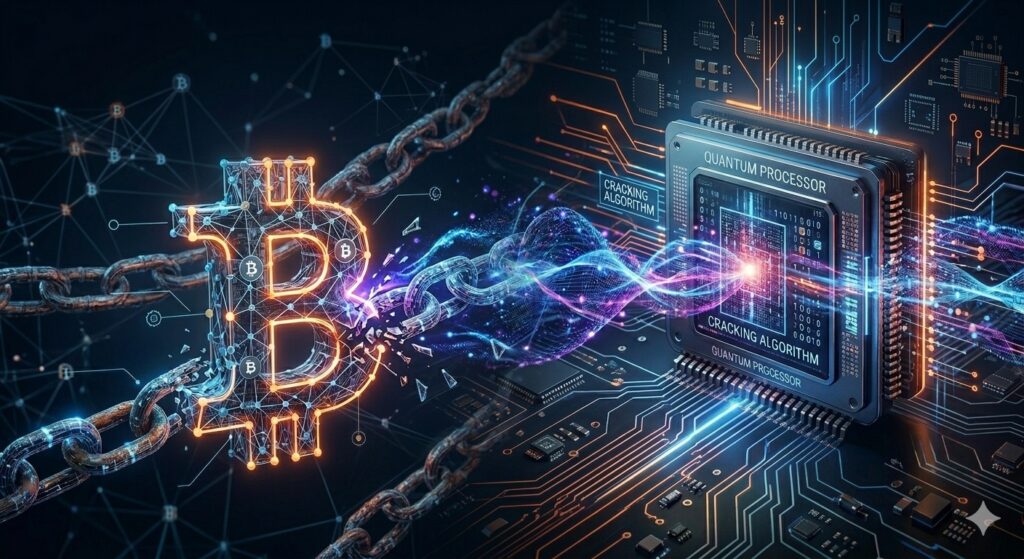

The intersection of quantum mechanics and cryptography represents one of the most significant technological pivot points of the 21st century. For decades, the security of our global financial systems, private communications, and the burgeoning world of decentralized finance has relied on mathematical problems that are “hard” for classical computers to solve. However, the emergence of functional quantum computers threatens to break the very foundations of this security, creating what many experts call the “Quantum Apocalypse” or the “Y2Q” moment. To understand the gravity of this threat, we must look beyond the hype and examine the specific algorithms that put digital assets at risk.
As a researcher who has followed the evolution of distributed ledger technology since its infancy, I have observed a recurring cycle of complacency followed by urgent adaptation. The threat of quantum computing is not a distant theoretical possibility but a looming structural risk. Current encryption standards like RSA and Elliptic Curve Cryptography (ECC), which secure 99% of today’s blockchain addresses and HTTPS connections, are uniquely vulnerable to quantum-scale processing. This article explores the technical nuances of this threat, the specific vulnerabilities within the crypto ecosystem, and the emerging field of post-quantum cryptography (PQC).
Understanding the Quantum Advantage: Shor’s and Grover’s Algorithms
The threat quantum computing poses to cryptography stems from two primary algorithms: Shor’s Algorithm and Grover’s Algorithm. Unlike classical computers that process bits as 0s or 1s, quantum computers utilize qubits, which exist in a superposition of states. This allows them to perform specific types of calculations at speeds that are exponentially faster than the most powerful supercomputers currently in existence. For the crypto world, this means that the “unbreakable” math protecting your private keys could potentially be solved in minutes rather than millennia.
The Death of Public-Key Infrastructure
Shor’s Algorithm is the primary weapon against modern encryption. It is designed to efficiently find the prime factors of large integers and solve discrete logarithm problems. Most cryptocurrencies, including Bitcoin and Ethereum, use the Elliptic Curve Digital Signature Algorithm (ECDSA). In an ECDSA-based system, a public key is derived from a private key through a one-way mathematical function. While it is virtually impossible for a classical computer to reverse this process, a quantum computer running Shor’s Algorithm could derive a private key from its corresponding public key with ease. This effectively renders any funds stored in a visible public address vulnerable to theft.
Weakening Symmetric Encryption and Hashing
Grover’s Algorithm presents a different kind of challenge. It provides a quadratic speedup for searching unsorted databases, which impacts symmetric encryption (like AES) and cryptographic hashing (like SHA-256). While Shor’s Algorithm “breaks” the math, Grover’s Algorithm “weakens” it. For instance, Grover’s can reduce the security of a 256-bit hash to only 128 bits. While this is a significant reduction, it is not considered fatal. The blockchain industry can largely mitigate this specific threat by simply increasing key lengths and hash sizes, making it a manageable risk compared to the existential threat posed to public-key signatures.
The “Harvest Now, Decrypt Later” Strategy
One of the most immediate and overlooked risks of quantum computing is the “Harvest Now, Decrypt Later” (HNDL) strategy. State actors and well-funded criminal organizations are currently intercepting and storing massive amounts of encrypted data. While they cannot read this data today, they are betting on the fact that quantum computers will eventually become powerful enough to crack the encryption in the future. This is particularly concerning for long-term holders of cryptocurrency and for sensitive information stored on blockchains that is intended to remain private for decades.
For the crypto industry, HNDL means that the transition to quantum-resistant standards must happen long before a “Cryptographically Relevant Quantum Computer” (CRQC) actually exists. If a user’s public key is already exposed on the ledger—which is the case for any address that has ever sent a transaction—that data is already being harvested. Once a CRQC arrives, those historic transactions can be audited, and any reused addresses or older wallet formats could be compromised retroactively. This highlights the urgent need for proactive migration strategies within the developer community.
Vulnerabilities Across the Blockchain Stack
The threat is not uniform across all digital assets. Different blockchain architectures and wallet types have varying levels of exposure to quantum attacks. To build a resilient ecosystem, we must identify the weakest links in the current infrastructure. From the way addresses are generated to the consensus mechanisms that secure the network, every layer must be scrutinized under the lens of quantum readiness.
- Legacy Bitcoin Addresses: Older Bitcoin addresses (Pay-to-Public-Key or P2PK) directly expose the public key on the blockchain. These are the most vulnerable to Shor’s Algorithm.
- Reused Addresses: Even with modern address types (P2PKH), the public key is revealed the moment a transaction is initiated. If the transaction remains in the mempool for a long period, a quantum attacker could potentially intercept it and redirect the funds.
- Smart Contracts: Many smart contracts rely on fixed cryptographic primitives. If the underlying signature scheme is broken, the logic governing the contract could be bypassed, leading to catastrophic liquidity drains in DeFi protocols.
- Proof of Work (PoW): While SHA-256 is relatively resilient due to Grover’s Algorithm, a massive leap in quantum hashing power could lead to a centralization of mining, as quantum-equipped miners would outpace classical ASICs.
The Road to Post-Quantum Cryptography (PQC)
The good news is that the cryptographic community is not sitting idle. The National Institute of Standards and Technology (NIST) has been leading a global effort to identify and standardize post-quantum cryptographic algorithms. These are mathematical problems that are believed to be resistant to both classical and quantum attacks. The primary candidates for PQC involve lattice-based cryptography, hash-based signatures, and multivariate equations. These methods are significantly more complex and often require larger key sizes, which poses a challenge for blockchain scalability.
Lattice-Based Solutions
Lattice-based cryptography is currently the frontrunner for replacing ECC and RSA. Algorithms like CRYSTALS-Kyber (for encryption) and CRYSTALS-Dilithium (for digital signatures) rely on the hardness of finding the shortest vector in a high-dimensional lattice. These problems are computationally intensive even for quantum qubits. Integrating these into blockchains like Ethereum will require significant upgrades, likely through soft forks or hard forks, to accommodate the increased data load of larger signatures.
Zero-Knowledge Proofs and Quantum Resilience
In the realm of privacy-preserving tech, Zero-Knowledge Proofs (ZKPs) are also being re-evaluated. Many current SNARK-based systems rely on elliptic curves, making them quantum-vulnerable. However, STARKs (Scalable Transparent Arguments of Knowledge) use hash-based functions, making them inherently more resistant to Shor’s Algorithm. As the industry moves toward Layer 2 scaling solutions, the adoption of STARK-based rollups may provide a natural path toward quantum security for the broader ecosystem.
Preparing for a Quantum-Resistant Future
The transition to a quantum-secure crypto world will be a multi-year, perhaps multi-decade, endeavor. It requires a coordinated effort between core developers, wallet providers, and exchanges. For individual investors, the best defense is to stay informed and utilize platforms that demonstrate a commitment to long-term security. We expect to see the emergence of “quantum-safe” wallets that utilize hybrid signature schemes—combining traditional ECC with a PQC layer to ensure security against both current and future threats.
Furthermore, the concept of “Crypto Agility” is becoming a standard in protocol design. Modern blockchains are being built with the ability to swap out cryptographic primitives without rebuilding the entire network. This flexibility will be crucial as NIST finalizes its standards and the first generation of quantum-resistant hardware becomes available. The threat is real, but it is also a catalyst for innovation that will ultimately make our digital financial systems more robust than ever before.
Conclusion: Is Crypto Doomed?
In short: No, but it must evolve. Quantum computing is a fundamental challenge to the status quo, but it is not an insurmountable one. The history of cryptography is a history of an arms race—new methods of breaking codes lead to the development of even stronger codes. While the transition will be technically demanding and likely cause periods of market volatility, the end result will be a more resilient decentralized infrastructure. By prioritizing post-quantum research today, we can ensure that the “Y2Q” moment is a seamless upgrade rather than a systemic failure. The future of value depends on our ability to outpace the machines that threaten it.