
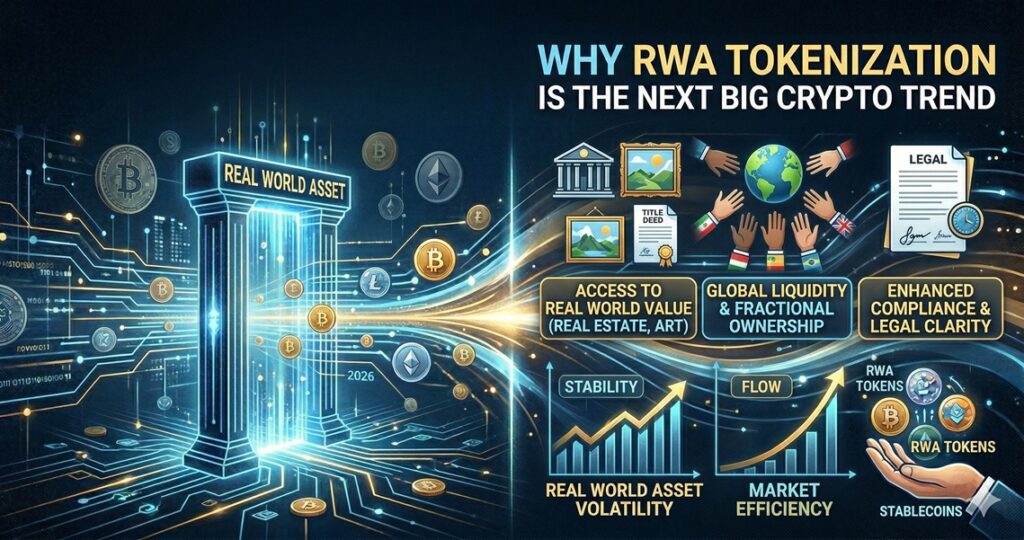

Real World Asset tokenization is moving from a niche crypto experiment into one of the clearest product-market fits in digital assets. The reason is simple: blockchains are good at recordkeeping, settlement, and transferability. Traditional finance is good at holding massive amounts of value, but it is slow, fragmented, and expensive to move. Tokenization connects those two systems.
Instead of treating blockchain as a place only for speculative tokens, institutions are now using it to represent treasuries, money market funds, private credit, funds, invoices, commodities, carbon credits, and even parts of real estate. That shift matters because it ties crypto adoption to cash-flowing assets, not just trading volume.
For readers trying to understand why this trend has momentum now, the answer sits at the intersection of regulation, rates, infrastructure, and institutional behavior. Higher interest rates made yield-bearing on-chain products more attractive. Better Layer 2 scaling lowered transaction costs. And clearer regulatory experimentation in places like the EU, Hong Kong, Singapore, and parts of the U.S. has made tokenization less theoretical and more executable.
Below is a practical, human explanation of why Real World Asset tokenization is likely to be one of the most important crypto narratives over the next several years.
What Real World Asset Tokenization Actually Means
Real World Asset tokenization is the process of issuing a blockchain-based token that represents ownership, economic rights, or claims on a real-world asset. That asset can be financial, physical, or contractual.
Common examples include:
- U.S. Treasury bills
- Money market funds
- Private credit positions
- Real estate interests
- Commodities like gold
- Invoice receivables
- Carbon credits
- Art or collectibles
The token itself does not magically create value. The value comes from the legal structure behind it: custody, enforceability, redemption rights, and the ability to verify that the underlying asset actually exists. That is why the strongest RWA projects are not just “on-chain assets.” They are financial products with legal wrappers, compliance layers, and audited reserves.
For a useful grounding in token standards and on-chain infrastructure, see the official documentation for Ethereum smart contracts and the Ethereum Improvement Proposals repository.
Why This Trend Is Growing Now
RWA tokenization has been discussed for years, but several market forces have finally lined up.
1. Higher interest rates made yield matter again
When treasury yields rose, investors started paying closer attention to safe, income-producing assets. That helped tokenized treasury products gain traction because they offered something crypto investors understand immediately: on-chain yield.
Tokenized treasuries are especially important because they function as a bridge between TradFi and DeFi. They can be used as collateral, parked in stable-value strategies, or held by institutions that want exposure to short-duration U.S. government debt without leaving blockchain rails.
2. Crypto users want less speculation, more utility
After several cycles dominated by memecoins, leverage, and narrative trading, a large part of the market has become more selective. Investors increasingly want assets with predictable cash flows, transparent backing, and lower correlation to pure speculative beta.
3. Institutions prefer assets they can explain to committees
It is much easier for a treasury desk or asset manager to justify tokenized U.S. Treasury exposure than it is to justify an experimental DeFi token. RWA products translate well into existing finance language: duration, yield, custody, counterparty risk, and settlement.
4. Blockchain infrastructure has become usable
Earlier tokenization efforts were held back by high fees and poor user experience. Today, Layer 2 networks and alternative chains give issuers lower-cost settlement and better scalability. This matters because RWA products need efficient transfer mechanics, frequent reporting, and sometimes high-volume micro-transactions.
For background on scaling, a helpful internal read is cryptotalks.io’s coverage of Layer 2 adoption and transaction efficiency.
What Makes RWA Tokenization Different From Normal Crypto Tokens
Most crypto tokens are native digital assets. RWAs are different because they depend on off-chain reality. That creates both strength and complexity.
| Feature | Native Crypto Token | RWA Token |
|---|---|---|
| Value source | Protocol utility, speculation, governance, fees | Underlying real-world asset and legal claim |
| Risk profile | Market, protocol, smart contract risk | All of the above plus custody, issuer, and legal enforceability risk |
| Demand driver | Trading, staking, DeFi usage | Yield, collateral use, settlement speed, portfolio access |
| Adoption path | Retail first in many cases | Institutional and enterprise often lead |
| Operational complexity | Mostly on-chain | On-chain plus legal, custodian, auditor, and transfer-agent layers |
This is why RWA tokenization is not just another crypto trend. It is a financial infrastructure story.
Where the Real Demand Is Coming From
Tokenized treasuries and cash management
This is the clearest use case today. Treasuries are familiar, liquid, and easy to benchmark. On-chain versions allow 24/7 transferability, programmable settlement, and integration into DeFi and institutional workflows.
BlackRock’s BUIDL fund is a strong signal that serious capital is taking this category seriously. For direct reference, see the BlackRock USD Institutional Digital Liquidity Fund. For broader market data, DefiLlama tracks tokenized treasury and stable-value protocols, while RWA.xyz offers a useful view of the sector.
Private credit
Private credit is one of the most promising and least talked-about RWA categories. The appeal is obvious: yield-seeking investors want access to lending products, and borrowers want faster capital formation. Tokenization can improve distribution and make these positions easier to package, monitor, and potentially trade.
The catch is underwriting. If the credit quality is weak, tokenization only makes bad loans easier to distribute. That is a key hidden risk many marketing decks skip.
Real estate
Real estate tokenization gets a lot of headlines, but execution is hard. Property ownership is jurisdiction-specific, illiquid, and often burdened by tax, title, and legal complications. Tokenization helps with fractional access and transferability, but it does not remove the fundamental friction of real estate.
In practice, the strongest real estate models will likely be income-producing assets with clean legal structures, not speculative luxury property plays.
Commodities and inventory finance
Gold, warehouse receipts, and supply-chain finance are attractive because they have clear economic utility. In these markets, blockchain can improve provenance, reduce reconciliation work, and speed up settlement between parties that do not fully trust each other.
Carbon markets and tokenized certificates
Carbon credits are another area where tokenization is attractive, but only if data integrity improves. If the underlying environmental claim is weak, the token becomes a wrapper around a bad asset. The technology can help with traceability, but it cannot fix fraudulent issuance by itself.
The Infrastructure Stack Behind RWA Adoption
Most people think tokenization starts and ends with the asset. It does not. The stack matters just as much as the asset itself.
- Blockchain settlement layer: Ethereum, Layer 2 networks, and other smart contract platforms
- Token standard: ERC-20, ERC-3643, or permissioned variants
- Custody: Qualified custodians, trust companies, and institutional vaults
- Identity and compliance: KYC, AML, transfer restrictions, whitelists
- Oracle layer: Price feeds, NAV updates, reserve attestations
- Legal wrapper: SPVs, trusts, fund structures, or securities issuance
- Distribution layer: exchanges, wallets, DeFi protocols, broker-dealers
This is where a lot of tokenization projects fail. They focus on the token and ignore the plumbing. Real adoption depends on whether the asset can move, settle, and redeem cleanly under real-world legal constraints.
For a deeper product-market angle, readers may also like cryptotalks.io’s analysis of institutional crypto adoption and cryptotalks.io’s guide to on-chain yield strategies.
Why Layer 2s and On-Chain Activity Matter
RWA tokenization has a very different transaction profile from meme trading. It needs low fees, predictable settlement, and smooth wallet UX. That is where Layer 2s become important.
If tokenized funds, invoices, or collateral positions move frequently, gas costs can destroy the product experience. Layer 2s reduce that friction and make micro-settlement, portfolio rebalancing, and compliance checks more practical.
More activity on-chain also creates better data. Wallet flows, redemption behavior, and liquidity depth become observable. That helps analysts, risk teams, and market makers understand where real demand exists.
In other words, RWA tokenization is not just bringing off-chain assets on-chain. It is also increasing the amount of economically meaningful on-chain activity. That is good for network utility, but it also makes transparency and surveillance a bigger issue.
Regulation Is Not a Side Note. It Is the Product.
If there is one thing serious tokenization builders understand, it is this: regulation is part of the user experience.
Most RWA products live in a securities-adjacent or fully regulated environment. That means token issuance, secondary trading, investor eligibility, disclosures, and custody all matter.
The U.S. still lacks a fully settled federal framework for many crypto asset categories, but legislative proposals such as the CLARITY Act materials on Congress.gov show that market structure remains a major policy focus. In parallel, the SEC, CFTC, and Treasury all influence how tokenized assets can be issued and distributed.
Outside the U.S., the direction is often clearer. The EU’s MiCA framework, Singapore’s MAS guidance, and Hong Kong’s digital asset regime have created more explicit pathways for compliant tokenization.
That regulatory clarity is important because large institutions do not want to build on a moving target. They want rulebooks, not vibes.
Market Context: Why This Could Become a Multi-Cycle Trend
Unlike many crypto narratives, tokenization is not purely dependent on retail enthusiasm. It can grow through asset managers, fintechs, banks, and corporates even during quieter market periods.
That makes RWA tokenization structurally different from most altcoin cycles. Its success is tied to:
- Interest rate regimes
- Institutional onboarding
- Stablecoin adoption
- DeFi collateral demand
- Regulatory progress
- Settlement and custody improvements
Stablecoins already proved that tokenized financial instruments can achieve product-market fit at scale. RWAs are the next logical extension. Instead of only tokenizing a unit of payment, the market is now tokenizing a unit of yield or ownership.
The Hidden Risks Most Articles Gloss Over
RWA tokenization sounds clean on paper. In reality, the failure modes are often non-technical.
- Custody risk: If the underlying asset is mismanaged, the token does not save you.
- Legal enforceability: A token claim is only as strong as the legal wrapper supporting it.
- Liquidity mismatch: A tradable token can still represent an illiquid underlying asset.
- Oracle dependence: Incorrect NAV or reserve data can distort pricing.
- Regulatory reclassification: A compliant setup today may face new rules tomorrow.
- Smart contract risk: Bugs, admin key abuse, and bridge failures remain real.
- False decentralization: Many RWA systems are more like fintech products with blockchain settlement than truly decentralized protocols.
The biggest mistake investors make is assuming tokenization automatically improves everything. It improves distribution and settlement. It does not eliminate credit risk, legal risk, or governance risk.
How to Evaluate an RWA Project Like a Pro
If you are looking at an RWA token or protocol, ask these questions:
- What is the underlying asset?
- Who holds custody?
- What legal entity issues the token?
- Can holders redeem, and under what conditions?
- Is the asset audited or independently verified?
- What happens if the issuer fails?
- Is secondary trading allowed, restricted, or purely theoretical?
- Does the token generate yield, and where does that yield come from?
- Which chain or Layer 2 is used, and why?
- How are transfers restricted for compliance?
These questions separate real financial products from glossy narratives.
Scenario Analysis: Where RWA Tokenization Goes From Here
Base case
Tokenized treasuries and private credit continue to grow steadily. Banks, fintechs, and asset managers use blockchain for settlement and distribution while keeping most products permissioned. DeFi begins to integrate tokenized collateral more deeply.
Bull case
Regulatory frameworks mature, major brokerages support tokenized funds, and settlement networks become interoperable across chains. RWAs become a standard part of treasury management and institutional portfolio construction. Tokenized assets become a major source of real on-chain value.
Bear case
Several high-profile failures, legal disputes, or reserve issues damage trust. Regulators tighten the rules sharply, and tokenized assets remain trapped in small, permissioned silos. Adoption continues, but slowly and mostly behind the scenes.
What Investors and Builders Should Watch Next
- More tokenized treasury products: a sign that the market is comfortable with on-chain yield
- Integration with major wallets and exchanges: improves distribution and access
- Greater Layer 2 usage: lowers operational costs and supports scale
- Clearer securities guidance: reduces legal ambiguity
- Real secondary liquidity: the difference between a demo and a market
- Institutional reporting standards: essential for serious capital
For market data and sector tracking, it is worth monitoring CoinGecko, CoinMarketCap, and Chainalysis research for broader adoption patterns and compliance trends.
Frequently Asked Questions
Is Real World Asset tokenization the same as tokenizing a stablecoin?
No. Stablecoins are usually tokenized payment instruments backed by cash or cash equivalents. RWAs are broader and can include securities, loans, property, commodities, and other contractual claims.
Are tokenized assets safer than regular crypto?
Not automatically. They may have more familiar collateral or yield mechanics, but they also add custody, legal, and issuer risk. The token wrapper is only one part of the picture.
Why are institutions interested in tokenized treasuries?
Because they combine low-risk yield with faster settlement, better transferability, and easier integration into digital asset workflows.
Will RWAs live mostly on Ethereum?
Ethereum is likely to remain a major settlement layer because of its liquidity, security, and developer base. But many issuers will also use Layer 2s and permissioned chains depending on cost, privacy, and compliance needs.
What is the biggest obstacle to adoption?
Not technology alone. The biggest obstacles are legal clarity, trust, redemption mechanics, and the gap between on-chain liquidity and real-world asset liquidity.
The Bottom Line
Real World Asset tokenization is becoming a major crypto trend because it solves a real problem: how to make traditional assets faster, more programmable, and easier to move without stripping away their underlying value. That is a far more durable use case than pure speculation.
The winners in this market will not be the loudest projects. They will be the ones that combine legal enforceability, clean custody, transparent reporting, and low-cost blockchain infrastructure. If crypto is going to grow up financially, RWAs are one of the places where that maturation will be visible first.
For investors, the signal to watch is simple: when tokenized assets stop feeling like experiments and start behaving like standard financial products, the trend will already be bigger than most people realize.