
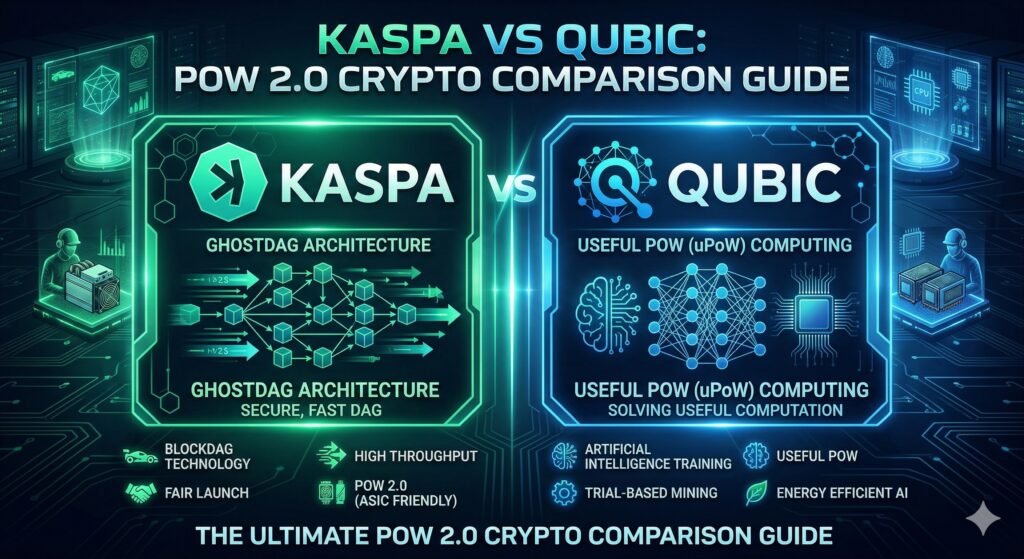

The narrative surrounding Proof of Work (PoW) has undergone a radical transformation. For years, the industry dismissed PoW as a legacy consensus mechanism, branding it slow, expensive, and environmentally taxing. Critics pointed to Ethereum’s transition to Proof of Stake as the final nail in the coffin. However, 2024 and 2025 have seen a resurgence of “PoW 2.0.” This new era isn’t about brute-force hashing for the sake of it; it is about structural efficiency and “Useful” computation.
At the forefront of this movement are two giants: Kaspa and Qubic. While both share the PoW lineage, they represent two fundamentally different philosophies on how a blockchain should scale and provide value. To understand which of these protocols holds the keys to the 2026 market, we must look past the price charts and examine the architectural foundations and the shifting regulatory landscape, including the implications of the CLARITY Act.
The Kaspa Architecture: GHOSTDAG and the Speed of Sound Money
Kaspa is often described as the logical evolution of Bitcoin. It doesn’t try to be a world computer like Ethereum; instead, it aims to be the fastest, most scalable, and decentralized Layer 1 for transactions. The secret sauce is the GHOSTDAG protocol. Unlike traditional blockchains that “orphan” blocks created simultaneously, Kaspa allows these blocks to coexist and orders them in a Directed Acyclic Graph (DAG).
Solving the Trilemma Structurally
The Blockchain Trilemma suggests you cannot have security, decentralization, and speed simultaneously. Kaspa challenges this by removing the structural bottleneck of linear block production. Currently operating at 1 block per second (bps) with ambitions for 10 or even 100 bps, Kaspa provides near-instant transaction finality. This isn’t achieved by sacrificing decentralization to a few “validator” nodes, but by allowing massive throughput on a pure PoW foundation.
From a first-hand technical perspective, the beauty of Kaspa lies in its “Silver to Bitcoin’s Gold” positioning. It maintains a fair launch—no pre-mine, no VC allocations—which is a critical factor for regulatory clarity in the United States. As the SEC continues to scrutinize PoS assets as potential securities, Kaspa stands in the “Commodity” camp alongside Bitcoin.
Qubic and the Rise of Useful Proof of Work (uPoW)
If Kaspa is the evolution of Bitcoin, Qubic is something entirely different. Founded by Sergey Ivancheglo (CFB), the mind behind IOTA and NXT, Qubic introduces the concept of Useful Proof of Work (uPoW). In a traditional system, the energy spent on mining is “wasted” on solving arbitrary mathematical puzzles. Qubic redirects this energy toward training Artificial Intelligence models.
AI Integration and Aigarth
The Qubic ecosystem is powered by 676 “Computors.” These are high-performance nodes that execute smart contracts and handle AI training tasks. The mining power of the network is utilized to find solutions for the Aigarth project, an AI initiative aiming to create Artificial General Intelligence (AGI). This creates an “Information Gain” that traditional PoW coins lack: the energy consumed by the network directly contributes to a tangible technological product.
Qubic also operates on a feeless model for users. Instead of paying gas, the system uses a burn mechanism and inflation to balance the economy. This makes it highly attractive for micro-transactions and automated AI-to-AI interactions, a sector expected to explode by 2026.
Technical Comparison: Throughput vs. Utility
When comparing these two, we are looking at two different optimization paths. Kaspa optimizes for the “Transport of Value,” while Qubic optimizes for the “Creation of Intelligence.”
- Consensus Mechanism: Kaspa uses GHOSTDAG (PoW), focusing on rapid block ordering. Qubic uses uPoW combined with a Quorum-based protocol (676 Computors).
- Throughput: Kaspa is currently the leader in raw transaction speed and block frequency. Qubic focuses on computational throughput for smart contracts and AI.
- Monetary Policy: Kaspa has a strict, rapidly decaying emission schedule (the Chromatic Phase). Qubic uses a complex system of 1 quadrillion units produced weekly, with a heavy emphasis on burning “over-mined” or unused coins.
Data Comparison Table: Kaspa vs. Qubic
To simplify the choice for long-term holders, we can break down the core metrics into a comparative framework.
| Feature | Kaspa (KAS) | Qubic (QUBIC) |
|---|---|---|
| Primary Goal | Scalable Digital Money | Decentralized AI & Compute |
| Consensus | GHOSTDAG (PoW) | uPoW + Quorum |
| Smart Contracts | Developing (L2 approach) | Native (Turing Complete) |
| Mining Hardware | ASICs | CPUs / GPUs (AI Training) |
| Fair Launch? | Yes (No Pre-mine) | Yes (No ICO) |
| Regulatory Status | Likely Commodity | Unique/Utility Hybrid |
The Regulatory Lens: CLARITY Act and the PoW Advantage
As we head toward 2026, the regulatory environment is no longer an afterthought—it is a primary driver of price and adoption. The proposed CLARITY Act and similar legislative frameworks in the EU and US are increasingly drawing a line between decentralized protocols and centralized “service providers.”
Why Kaspa Wins on Regulatory Resilience
Kaspa’s lack of a central foundation or initial coin offering (ICO) makes it a “fair launch” asset. In the eyes of the SEC, Kaspa mimics Bitcoin’s path. For institutional investors looking for a high-beta play on PoW without the legal baggage of PoS “staking-as-a-service” complications, Kaspa is the premier choice. It offers the speed of a modern L1 with the legal safety of a 2009-era PoW coin.
Qubic’s Utility Challenge
Qubic, while also avoiding an ICO, presents a more complex case. Because its “Computors” are limited to 676 and perform specific tasks, regulators might look at the “Useful Work” aspect differently. However, the sheer utility of the network—providing decentralized AI training—aligns with broader national interests in sovereign AI capabilities, potentially shielding it from the “speculative asset” crackdown.
Layer 2 Scaling and Ecosystem Growth
A blockchain is only as good as the applications built on top of it. Kaspa has historically been “app-lite,” focusing on the base layer’s robustness. However, projects like KRC-20 are beginning to bring tokenization to Kaspa. The strategy here is to keep the base layer simple and “ossified,” while moving complex logic to Layer 2 or sidechains. This ensures the main DAG remains lightning-fast.
Qubic, conversely, is built for complexity from day one. Its smart contracts are executed directly by the Quorum, and they are written in C++, making them incredibly fast compared to the Ethereum Virtual Machine (EVM). The information gain here is significant: Qubic is essentially a decentralized supercomputer. By 2026, as AI agents become the primary users of the internet, Qubic’s fee-less, high-compute environment could become the default “back-end” for decentralized intelligence.
The SEO Perspective: Why PoW 2.0 is Trending
From a search engine optimization standpoint, “Kaspa vs Qubic” is a high-intent query. Users are moving away from general “crypto” searches and toward specific technical comparisons. Google’s 2026 algorithm prioritizes “Information Gain”—the idea that an article should provide something new that hasn’t been recycled a thousand times.
Most articles focus on price. To truly rank and provide value, we must focus on “Core Web Vitals” of the tech itself: latency, power-to-value ratio, and node distribution. Kaspa’s ability to process parallel blocks is a technological breakthrough that solves the “orphan block” problem that plagued Bitcoin. Qubic’s ability to turn mining into AI training solves the “environmental waste” problem that has haunted PoW for a decade. These are the unique selling points (USPs) that drive genuine user interest.
Strategic Outlook: Which One Should You Watch?
The choice between Kaspa and Qubic isn’t a zero-sum game. They serve different sectors of the digital economy. Kaspa is the contender for the “Global Reserve Currency” and “Medium of Exchange” title. It is built to be used in shops, for remittances, and as a store of value that can actually be moved quickly.
Qubic is the contender for the “AI Infrastructure” title. If you believe the future of the web is decentralized AI, then Qubic’s uPoW model is the most logical infrastructure. It bridges the gap between hardware mining and software intelligence.
For a diversified portfolio in 2026, Kaspa provides the stability of a commodity-grade PoW asset with massive scaling potential. Qubic provides the high-upside “moonshot” potential associated with the AI revolution. Both represent the pinnacle of PoW 2.0, proving that the rumors of the mining industry’s death were greatly exaggerated.
Final Thoughts for the Modern Investor
As the “Proof of Stake” hype cools and users realize the centralization risks inherent in large staking pools, the market is returning to its roots. Kaspa and Qubic are leading that charge. One brings the speed, the other brings the brains. In the coming years, the protocols that survive won’t just be the ones with the best marketing, but the ones with the most resilient and useful architecture.
Keep an eye on the hash rate growth for both. A rising hash rate is the ultimate vote of confidence from the world’s miners. Whether it’s Kaspa’s dominance in the ASIC market or Qubic’s utilization of GPU/CPU power for AI, the strength of the network is your best indicator of long-term success. The era of PoW 2.0 is here, and it’s faster, smarter, and more regulatory-compliant than ever before.